Back to Blog
- What is cyber readiness?
- Traditional cybersecurity training does not build readiness on its own
- Why measuring cyber readiness is critical
- How to improve cyber readiness after you measure it
- Cyber readiness vs training: The bottom line
- Stop reporting activity and start proving readiness
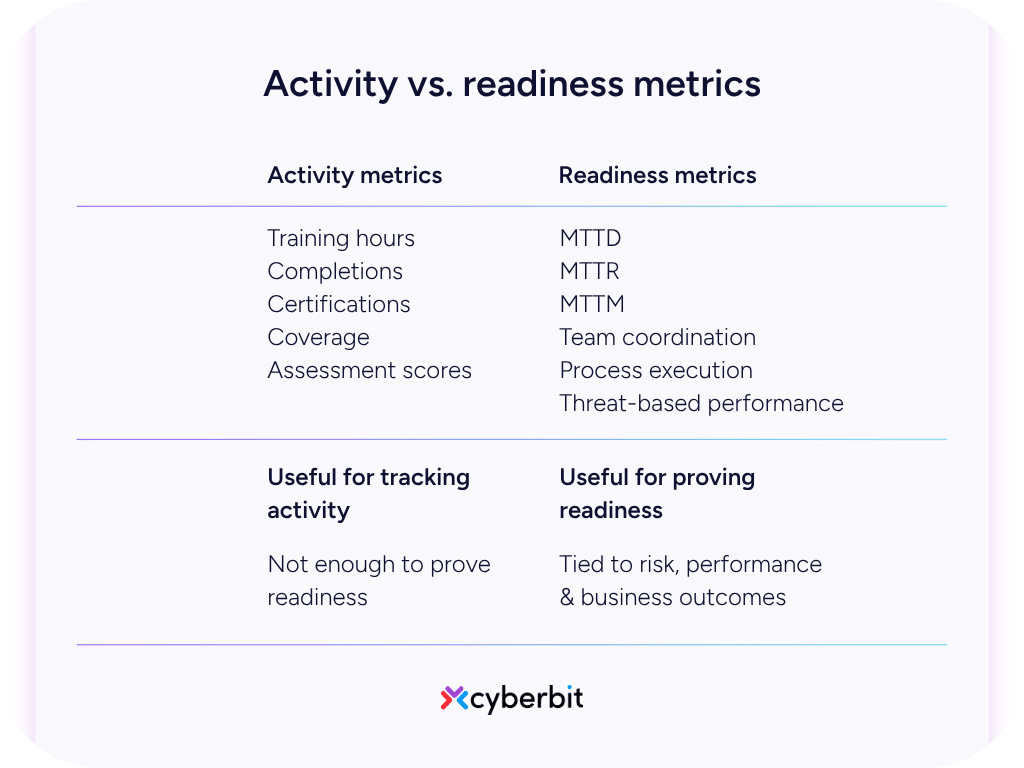
Most security teams already measure … something. They track training hours, course completions, certifications, framework coverage, or time spent in labs. Most organizations can report on training activity like this but very few can prove defensive readiness against real attacks.
Training metrics are easy to collect, easy to report, and easy to compare over time, but they are not the same as readiness. Cyber readiness is a team’s proven ability to defend the business during a real cyber attack.
A team does not become ready because it finished more training. A team becomes ready when it proves it can detect, communicate, investigate, and respond under pressure against the attacks it is most likely to face. That is a different standard, and it needs a different way to measure progress.
What is cyber readiness?
Cyber readiness is the demonstrated ability of a security team to detect, investigate, communicate, respond, and recover in a way that reduces real risk during an incident. For a security leader, that risk is not only a technical risk; it represents the risk of operational disruption, reputational damage, supply chain impact, regulatory exposure, and financial loss.
Readiness is broader than awareness, broader than training, and broader than technical proficiency in one tool or workflow. It gives security leaders a stronger way to connect team performance to business outcomes, justify investment, and explain risk to the board.
NIST CSF 2.0 is a useful resource here because it treats cybersecurity as a set of outcomes across Govern, Identify, Protect, Detect, Respond, and Recover, which reinforces the idea that readiness is operational and cross-functional, not isolated to a course or certification.

In practical terms, cyber readiness means a Security Operations Center (SOC) does not just know what good response looks like on paper, but it can actually perform under pressure. Attack-ready SOCs can detect the signal, coordinate across roles, make decisions, escalate correctly, and contain the attack before business damage spreads.
Traditional cybersecurity training does not build readiness on its own
If you’re here because you’re asking whether your current training, tooling, and staffing translate into defensive capability, I’m afraid I’ll have to disappoint you.
Traditional training still matters, though. Courses, labs, and certifications help people learn terminology, workflows, detection logic, and tool usage. They help individuals build technical skills. What they do not reliably do is prove that a team is ready for a live incident.
We often hear a version of the same story from organizations with experienced analysts, mature tooling, and a strong SIEM:
“We thought the team was ready, but when the attack started, people froze, no one knew where to begin, and communication broke down.”
Individual knowledge does not automatically turn into coordinated action under pressure.
CISA’s training resources and tabletop exercise packages show this distinction clearly. While training builds knowledge, it’s only through exercises stakeholders learn how to respond to realistic scenarios across the incident lifecycle.
That gap shows up in real operations.

A team may know how to analyze indicators of compromise but still fail to communicate clearly. An analyst may know a detection workflow but freeze when multiple decisions hit at once. A manager may have a response plan, but the plan may break down when the team disagrees, loses context, or misreads attacker behavior.
Legacy training often builds only one or two skills in a capability, while soft skills, process execution, attack chain knowledge, and adversarial knowledge are ignored or rarely practiced. Exercising helps close that gap by building team confidence, communication, collaboration, and the ability to make decisions when the situation is noisy, fast-moving, and unclear.

The reality is that threats, teams, and technologies constantly change, while skills fade, and traditional programs struggle to stay aligned to risk. NIST SP 800-61 Rev. 3 explicitly places incident response inside broader cybersecurity risk management rather than treating it as a separate technical task, which supports the idea that preparedness has to evolve with the organization and its threat environment.
That is why “more training” is not the same as more cybersecurity readiness. Activity is easy to measure, but it can become a false proxy. Hours, completions, and certifications are visible, but they do not show whether a team is prepared for an actual incident.
Why measuring cyber readiness is critical
If you do not measure readiness, you end up measuring what is easiest to count. That usually means participation, completion, or framework mapping. Those metrics tell you whether something happened. They do not tell you whether the team can defend against the attacks that matter to the business.
Organizations need measurement programs that tie security efforts to meaningful outcomes, not just raw activity.
This becomes even more important at the leadership level. Security practitioners talk in terms of TTPs, detections, investigations, and adversary behavior. Executives talk in terms of risk, exposure, investment, and resilience. A good readiness model creates a translation layer between those two views.
Public frameworks support this shift. The CISA Cyber Resilience Review is built as an assessment of operational resilience and cybersecurity practices, including the ability to manage risk during normal operations and times of crisis. That tells you something important about the broader market.
Readiness is increasingly being treated as an operational capability, not just a training program.
This is also where cybersecurity readiness becomes a business issue, not only a technical one. If you cannot show how your team performs against likely threat scenarios, it becomes difficult to justify spend, prioritize improvements, or explain residual risk to leadership.
Readiness should be accountable to risk and budget and treated as a measurable outcome rather than an opaque benefit.
How to measure cybersecurity readiness
The most useful way to measure cybersecurity readiness is through realistic, repeatable exercises that observe team performance against relevant threats.
A strong readiness model usually includes three parts.

1. Run a team exercise
First, run an exercise based on a known adversary playbook or a threat scenario relevant to your environment. The exercise should map to your likely risks, not a generic challenge detached from business context. Cloud-based cyber ranges are ideal for simulating a hyper realistic attack scenario.
2. Observe, measure, and analyze performance
Observe how the team performs across the full incident, not just whether one person solved a technical puzzle. That includes detection, triage, communication, escalation, investigation, decision-making, and response under time pressure. This is where readiness becomes broader than technical skill.
Then turn the exercise outcome into measurable readiness data by mapping the outcome to an adversary level, and track measurable progress. Metrics such as Mean Time to Detect (MTTD), Mean Time to Respond (MTTR), Mean Time to Mitigate (MTTM), technical skills gaps, and soft skills analysis show how the team performed in context, not just how many labs they completed.

3. Fix gaps
Compare current performance to the threat level your organization actually faces, then track progress over time and identify gaps across team skills (technical and soft skills), capabilities, experience, tools, and processes.
What good cyber readiness metrics look like
A good cyber readiness measurement model should combine speed, quality, coordination, and relevance to risk.
Speed matters because incident response is time-sensitive. Metrics such as MTTD and MTTR show whether the team is getting faster at finding and containing threats.
Quality matters because fast but wrong decisions are still failures. Exercise evaluation should capture investigative accuracy, quality of escalation, containment quality, and whether the response matched the threat.
Coordination matters because incidents pressure-test communication, leadership, and process execution. If handoffs are poor or roles are unclear, individual skill will not carry the team very far. Consider soft skills and process execution a critical part of readiness rather than as secondary concerns.
Relevance to risk matters because a team should not be measured against abstract maturity alone. It should be measured against the attacks, attacker sophistication, and business exposure that define its real threat profile.
How to improve cyber readiness after you measure it
Measurement is only useful if it changes what happens next. The goal is not to collect another dashboard. The goal is to identify what broke during the exercise, then close those gaps in a structured way.
- Run an exercise relevant to your risk.
- Analyze the performance data.
- Identify skills gaps and bad processes.
- Fix those gaps through targeted labs or custom content.
- Run the next risk-based cycle.
This is also where readiness becomes more practical than one-off training.
Instead of hoping people choose the right content, the improvement path becomes tied to what the team demonstrated in a realistic scenario. That makes the program easier to defend internally because it is tied to risk, performance, and business relevance rather than generic development goals.
Cyber readiness vs training: The bottom line
Training prepares people. Readiness proves performance.
That is the cleanest way to separate the terms. Training gives defenders knowledge, tool familiarity, and technical practice. Cyber readiness shows whether that knowledge holds up when the team has to detect, communicate, investigate, and respond in a real incident.
Public guidance from NIST, CISA, and ENISA all point toward the same conclusion: preparedness improves when organizations tie incident response to risk management, run realistic exercises, and evaluate outcomes in a structured way.
At the end of the day, readiness should answer one simple question:
Can our team defend against the adversaries that are actually targeting organizations like ours?
Stop reporting activity and start proving readiness
Cyber readiness is not another word for training. Readiness sets a higher bar.
It means your team can perform under pressure against the threats that matter to your organization. It means you measure outcomes, not just effort. And it means you improve readiness through realistic exercises, structured evaluation, and targeted follow-up, not through activity metrics alone.
If your organization still reports cybersecurity training activity as proof of preparedness, there is a gap between what is visible and what is true.
See what cybersecurity readiness looks like in practice, move beyond training metrics, and see how your team performs against the threats that matter.

- What is cyber readiness?
- Traditional cybersecurity training does not build readiness on its own
- Why measuring cyber readiness is critical
- How to improve cyber readiness after you measure it
- Cyber readiness vs training: The bottom line
- Stop reporting activity and start proving readiness
