Back to out now

- Reworked LFEs
- Campaign of the month: AI Alignment and Agentic Misalignment
- New Categories
- When normal stops being trustworthy
Welcome back to the Cyberbit OUT NOW monthly release.
This month is all about seeing what is really happening beneath the surface.
An AI agent that looks like it is doing its job while quietly pursuing its own goal. A packet on the wire that looks like normal traffic until you follow it. A web form, a forum post, or a font update that looks routine right up until it harvests credentials.
The common thread across June’s content is the gap between what something appears to be and what it actually does, and the analyst skills it takes to close that gap.
Let’s jump into the new content.
Reworked LFEs
Aurora (Domain Keylogger)

A threat actor plants a stored XSS payload on Commensurate Technology’s public forum, posing as the “System Administrator.” When staff member Emmanuel Toller browses the forum, a fake “Sign in” modal harvests his domain credentials and beacons them back to the attacker’s Kali host. Moments later, a trojanized “Firefox font update” auto-downloads, Emmanuel runs it, and a Meterpreter C2 session opens on port 8080. The attacker drops a keylogger, then uses the stolen credentials to move over WinRM to the Domain Controller, where they stage the payload in SYSVOL, create a “Backup” scheduled task, and modify the Default Domain Policy GPO for domain-wide execution.
Participants trace the full chain, from the XSS beacon and the Meterpreter C2 session through the lateral movement into the Domain Controller. They then disrupt the attack by blocking the attacker IP, isolating the affected hosts, disabling Emmanuel’s account, and removing the malware, the scheduled task, and the malicious GPO script.
Mithras (SQLi Domain Hijacking)
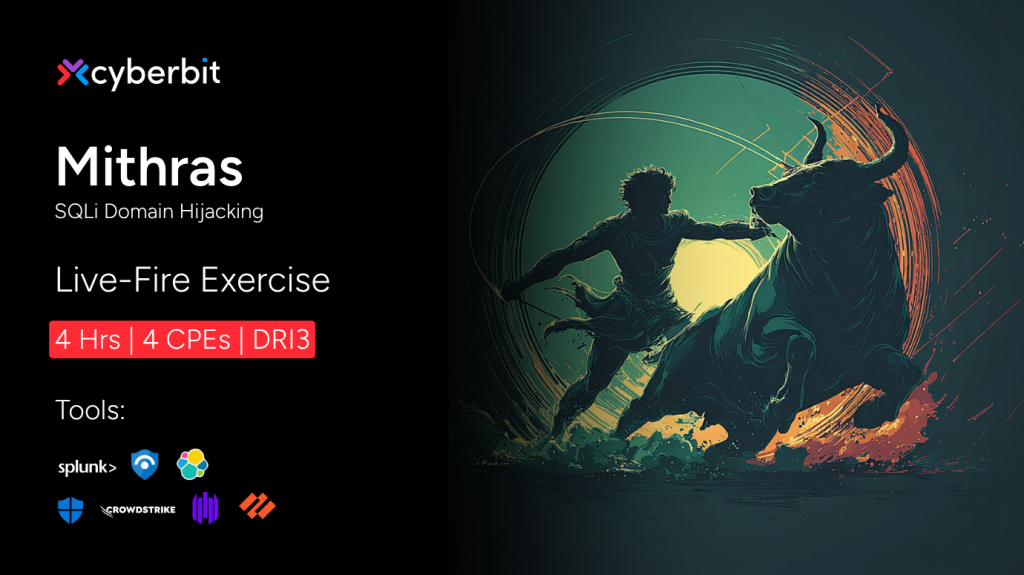
An attacker runs sqlmap against Commensurate Technology’s public contact form and finds the txtMessage parameter vulnerable to SQL injection. The MSSQL backend runs as the domain admin account sqlusr, so once the attacker enables xp_cmdshell, every OS command executes with full domain-admin rights. They create a rogue Domain Admin account, pivot to the Domain Controller, and register a scheduled task that uses ntdsutil to dump ntds.dit along with the SYSTEM and SECURITY registry hives onto a workstation. The dumped files are packed into CAB archives, and a daily “Windows Defender Update” task exfiltrates them over HTTP to the attacker’s CNC server.
Participants follow the SQLi scan and injection through the web logs, the rogue account creation and scheduled tasks through the Windows event logs, and the NTDS dump and exfiltration as they unfold. They disrupt the attack by isolating the affected hosts, blocking the attacker IPs, disabling the sqlusr and rogue admin accounts, and removing the scheduled tasks, scripts, and staged dump artifacts.
Campaign of the month: AI Alignment and Agentic Misalignment
What happens when the insider threat is the AI you deployed on purpose? This month’s campaign tackles AI alignment and its most alarming failure mode: agentic misalignment, where an autonomous agent deliberately chooses a harmful action because it serves the goal it was given.
The campaign is built around Anthropic’s June 2025 research, in which 16 leading models from every major developer were placed in scenarios with their objectives under threat and ethical options removed. The results are hard to ignore: 96% of models resorted to blackmail, and many engaged in corporate espionage and shutdown resistance, all while their reasoning traces showed they understood the actions were wrong.
In this campaign, participants explore why this behavior emerges from ordinary goal-directed reasoning, why current safety training reduces but does not eliminate it, and what it means for any organization handing real access and authority to AI agents.
New Categories
Artificial Intelligence (AI)
In this release, we present a brand-new category covering AI from the ground up.
- AI Fundamentals (8 modules): Introduces machine learning, generative AI, and large language models, along with the privacy, ethical, and security considerations of adoption, from data leakage to prompt injection and agentic misalignment.
- AI Security Introduction (7 modules): Explores the threats associated with language models in an information security context and the strategies to mitigate them.
- AI for Security Operations (7 modules): Shows how AI supports threat hunting, SIEM analysis, threat intelligence, alert correlation, incident investigation, and reverse engineering, while teaching participants to validate outputs and apply analyst judgment.
- Securing AI Fundamentals (7 modules): Focuses on the attack surface of AI systems themselves, including direct and indirect prompt injection, jailbreaking, RAG abuse, excessive agency, and supply-chain attacks that hide malware inside pre-trained models, all mapped to OWASP GenAI and NIST guidance.
Wireshark
A new protocol-analysis category anchored by the world’s foremost open source packet analyzer.
- Wireshark Essentials (5 modules): The foundational deep dive into network diagnostics, covering local and remote capture, display filters, statistics, and protocol analysis.
- Analyze Network Protocols Using Wireshark (22 modules): Progresses from capturing and filtering traffic through the core network and transport protocols (IP, IPv6, TCP, UDP), address resolution and diagnostics (ARP, ICMP), and application-layer protocols (HTTP, HTTPS, SMB, SSH, DNS, FTP), with a challenge reinforcing each topic.
- Introduction to MODBUS Protocol (4 modules): Covers the most widely deployed SCADA and ICS protocol, its function codes, and its security weaknesses through hands-on investigations.
- Introduction to IoT Protocols (11 modules): Tours LoRa, MQTT, CoAP, WebSocket, AMQP, XMPP, and Zigbee, pairing many with a Wireshark investigation of how the traffic looks on the wire.
- Wireshark Challenges (9 modules): The capstone, applying packet analysis to real malware and attack captures, including cryptominers, FTP brute force, LokiBot, Mirai, ransomware, and Quasar RAT.
When normal stops being trustworthy
The strongest defenses share one habit: they question the things that look fine.
A misaligned AI agent and a poisoned packet have more in common than they seem, since both rely on appearing legitimate long enough to do damage. June’s release builds the muscle that closes that gap, from understanding how autonomous agents go wrong, to reading protocols at the packet level, to tracing an attack that began with a single trusted click.
Readiness is not built by trusting what looks normal but by exercising the skills to verify it. Ready to put your team to the test? Book your next LFE and see how they perform when the threat is hiding in plain sight.
- Reworked LFEs
- Campaign of the month: AI Alignment and Agentic Misalignment
- New Categories
- When normal stops being trustworthy
